
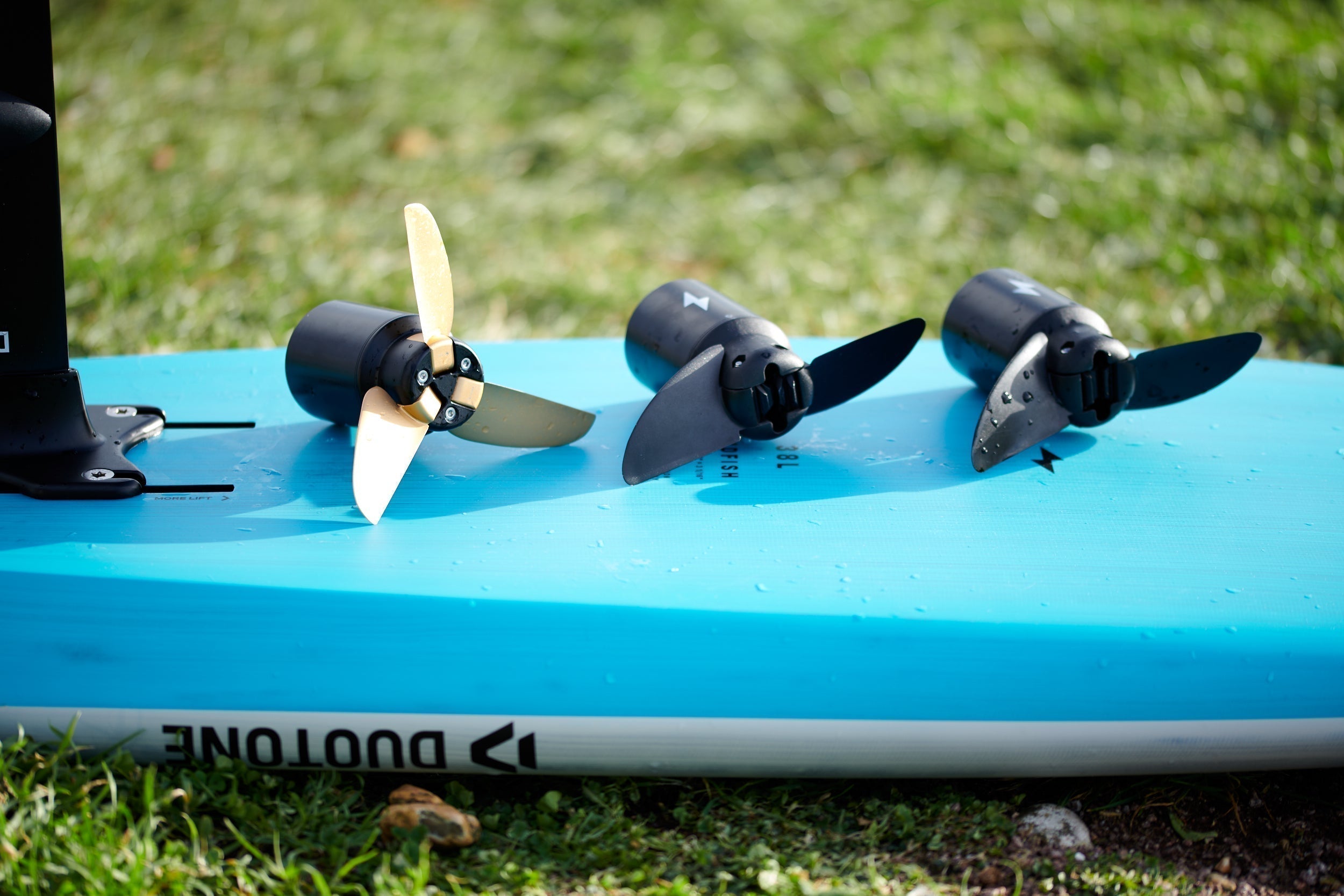
Plastic vs SLS 2-Blade vs 3-Blade Propellers
Over the last few months, I’ve been spending more and more time on the Duotone Foil Assist system, and today I finally had the chance to properly back-to-back test all three propeller options in real UK conditions.
This wasn’t a flat-water lake test. This was winter on the south coast.

Test locations & conditions
-
Morning: Shoreham
Low tide, cold winter morning, sun shining with a really nice ground swell running
-
Afternoon: Goring
Higher tide, smoother water between sets, more forgiving surface to focus on technique
Cold hands, winter wetsuit, proper British conditions.

Equipment used
-
Board: Duotone Mid Fish – smallest size ( 38 litres)
-
Foil Assist: Duotone Foil Assist aluminium system
-
Front Wing: Duotone Crest 925
-
Tail: Duotone Aero Monoblock Tail
-
Rider weight: 70–72 kg
This is important because rider weight turned out to be the biggest factor in the conclusions below.

The three Duotone Foil Assist propeller options explained
The Duotone Foil Assist system currently offers three propeller setups:
-
Plastic propellers (included as standard)
-
Duotone SLS aluminium 2-blade propellers (upgrade, available now)

I’ve now ridden all three, including multiple sessions on the 3-blade, and here’s how they genuinely compare.
Plastic propellers – slowest, safest, most forgiving
The plastic propellers come included with every Duotone Foil Assist kit, and there’s a very good reason for that.
How they feel on the water
-
Lowest thrust and lowest top speed
-
Requires the highest gearing on the remote
-
I was riding 7 out of 7 almost all the time
-
Extremely forgiving if the props breach the surface
-
Smooth and predictable from stationary to foiling
Even when the propeller briefly comes out of the water due to chop, mast height or body movement, the plastic blades are much more forgiving. That makes them ideal when learning.
Who they’re for
-
Beginners and first-time Foil Assist riders
-
Lighter riders
-
Anyone prioritising safety and confidence
-
Riders learning throttle control and take-offs
When the battery is fresh and fully charged, there is still plenty of usable speed. The key thing is consistency and forgiveness.
Our recommended approximation rider weight range:
Up to around up to 80kg, depending on skill level
SLS aluminium 2-blade propellers – the sweet spot for most riders
For me personally, this is where everything clicked.
The SLS aluminium 2-blade propellers offer a noticeable jump in performance over the plastic blades, without becoming overpowering.
How they feel on the water
-
More thrust and faster acceleration than plastic
-
Still very controllable and predictable
-
Cruising comfortably at gear 5–6
-
Full power gear 7 when entering waves
-
Smooth vertical lift without porpoising
Most importantly, I fell off far less on this setup compared to three blades That meant longer rides, more waves caught, less relaunching and better real-world efficiency.
This is where the idea of “efficiency” really matters. Staying on the foil uses far less battery than falling off and restarting repeatedly.
Who they’re for
-
Intermediate to advanced riders
-
Anyone wanting more speed and performance
-
Riders who are confident on Foil Assist but don’t want overpowering thrust
-
Lighter to mid-weight riders wanting control
Estimated rider weight range:
Roughly up to 95 kg, depending on experience and foil size
This ended up being my personal sweet spot at 70–72 kg.
👉 Duotone SLS 2-Blade Metal Propeller Upgrade:
https://worthingwatersports.com/products/dte-epropeller-2-blade-sls-2pcs-2026
SLS 3-blade propeller – huge power, weight dependent
The 3-blade propeller system is the most powerful option and uses a different design to the 2-blade setup. Each blade tucks away individually, similar to traditional foil- drive systems.
I’ve now ridden this system multiple times, including today in flatter, more forgiving conditions.
How it felt for me (70–72 kg)
-
Significantly more thrust
-
Riding around gear 4–5 instead of 6–7
-
Very fast vertical lift
-
Nose lifts extremely quickly
-
Led to porpoising and nose burying
-
Resulted in getting launched off the board
I moved my mast right back and had much smoother water to focus on technique. Even then, the issue remained.
This wasn’t a technique problem. It was simply too much power for my body weight.
Because I don’t have much weight above the board, the extra thrust lifts the nose faster than I can naturally counterbalance. That means I have to actively push the board down, which then overcorrects and causes instability.
A very important clarification
This does not mean the 3-blade is a bad system.
It means it’s rider-weight and setup dependent.
For heavier riders or riders on extremely small foils, this extra thrust will be a huge advantage.
Who the 3-blade is ideal for
-
Heavier riders
-
Riders 75–80 kg and above
-
Very heavy riders (90–110 kg)
-
High-performance riders on very small foils
-
Anyone who genuinely needs maximum thrust to get flying quickly
Some people assume more propellers automatically equals better efficiency. In reality, if the power overwhelms your weight and technique, you’ll waste far more energy falling off and relaunching.
Efficiency comes from staying on the foil.
👉 Duotone SLS 3-Blade Propeller (price & availability TBC):
https://worthingwatersports.com/products/dte-epropeller-3-blade-sls-with-mount-2026
Final thoughts – choose propellers by rider weight, not hype
After real UK testing in winter conditions, my biggest takeaway is simple:
Propeller choice should be based on rider weight and control, not headline power or efficiency claims.
-
Plastic props = safest, smoothest learning tool
-
SLS 2-blade = best all-round performance for most riders
-
3-blade = serious power for heavier or high-performance riders
If you get the wrong prop for your weight, you’ll fall off more, fatigue faster and use more battery overall.

Duotone Foil Assist kits
If you’re starting from scratch, you can view all complete Duotone Foil Assist kits here:
https://worthingwatersports.com/collections/duotone-foil-assist-complete-sets-kits
If you’re unsure which propeller option is right for your weight, foil size or riding style, just get in touch. We’re always happy to talk it through properly.