
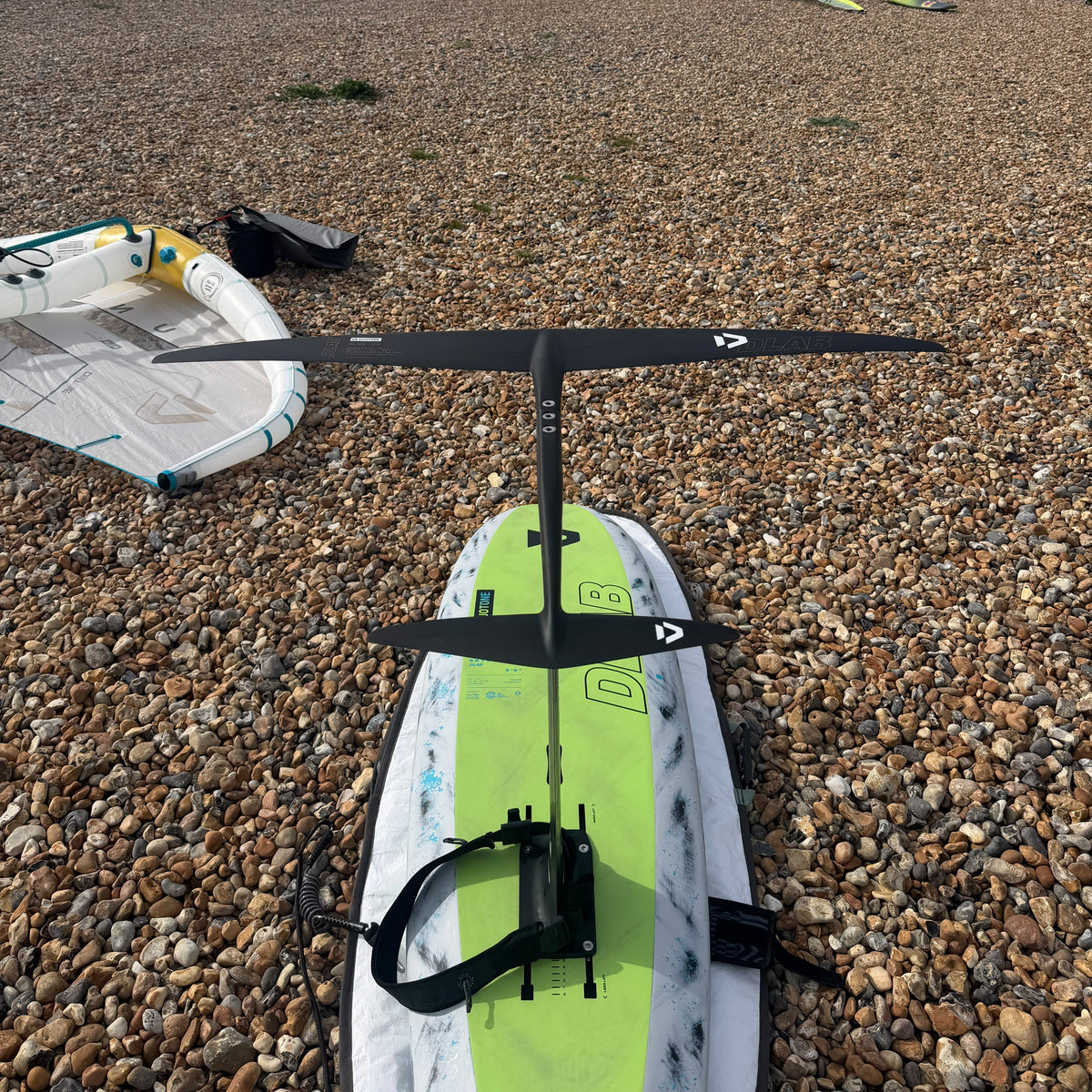
The Glide 3.0 950 is the latest size in Duotone's wing foil front wing range, and Mike's test session showed exactly why it's earned its reputation: outstanding glide and wave-connecting ability that make it a strong pick as a larger foil for smaller swell days. Mike, a customer who's been riding the Glide 2.0 for a couple of seasons, took the new 950 out at Shoreham and put it through its paces against his old foil and against Duotone's more manoeuvrable Crest.
Three sessions, three tail options, and a lot of back-to-back swaps later, here's his full verdict — including which tail to buy if you only ever buy one.
|
87kg
Tester weight
|
Skybrid D/LAB 80L
Test board
|
20–30kts
Wind, Shoreham
|
0.5–1.5m
Swell tested in
|
Ease of use
First thing Mike noticed: the Glide 3.0 is noticeably more forgiving than the 2.0, especially in the messy coastal chop we get off Shoreham. If you found the 2.0 a handful in anything less than glassy conditions, the 3.0 has closed that gap considerably.
Glide and low end
This is where the 950 does its talking. Glide and wave-connecting ability are outstanding — Mike linked distant swells he wouldn't have got near on the old foil. The trade-off is that the higher aspect ratio wants a touch more board speed to get up on foil than a comparable Crest. Once it's up and flying, though, it holds that speed far better than the Crest does.
Use case: this is the one to reach for as a bigger foil on smaller swell days, and it's a genuinely strong choice for parawing, where maximum glide is everything when you're stashing the wing and riding the swell alone. It's just as happy blasting around on flat water.
"The amount of waves I was able to link was insane."
— Mike, Worthing Watersports customer, wing foiling off Shoreham
Manoeuvrability and stall speed
Duotone have made a real step forward over the 2.0 here. Tip breaches during aggressive carves — the moment that used to end the ride — are recoverable on the 3.0. It's still not quite as forgiving through a hard carve as the Crest, but it's a different foil to ride than its predecessor.
Stall speed has improved just as much. In genuinely extreme, super-slow stalls the Crest can still be saved where the Glide 3.0 will drop out — but across the usable low-end range you'll actually ride in, it holds on solidly.
Pumping
The Glide 3.0 leaves the Crest well behind for pump efficiency and glide between swells — but how much of that you feel depends heavily on which tail it's set up with. That's the next bit.
Which tail should you run?
Mike ran all three of Duotone's MB tails behind the 950 across his test sessions. Each changes the character of the foil more than you'd expect from a tail swap.
| Tail | Best for | Pros | Cons |
|
MB-H150-40 Best glide / most technical |
Parawing, distance riding | Peak glide efficiency, by far the most efficient pump, effortless connection of distant swells | Feels spanny and cumbersome, demanding pitch control, unforgiving if you catch a rail |
|
MB-S160-40 Top pick / best all-rounder |
Most riders, most days | Agile, manoeuvrable and fun, better pitch control and low-speed stall handling than the H tail, easier to pump when tilted at an angle | Slightly less raw glide than the H150, though still pumps effortlessly enough to link waves |
|
MB-PX145-40 Most control |
Rough water, steep faces | Most confidence-inspiring, best pitch stability, predictable control in rough water and steep critical sections | Hardest tail to pump, needs significantly more leg work to bridge gaps between swells |
Back-to-back: Glide 3.0 950 vs the Crest
Mike ran three direct comparisons against the Crest over the test period, swapping foils session to session in matched conditions.
1. Glide 3.0 950 + H150 vs. Crest 925 + PX145
22–30kts, 1.0–1.5m swell
The Glide 3.0's glide was far superior — the amount of waves Mike was able to link was, in his words, insane. It got up on foil faster than the Crest when riding with the swell, but slower riding against it, and pitch control was tough on steeper sections — enough that Mike found himself hunting out flatter waves to link together. The Crest, in contrast, gave superior pitch control and comfort, and invited harder, more aggressive carving on the steeper faces.
2. Glide 3.0 950 + PX145 vs. Crest 925 + PX145
22–30kts, 1.0–1.5m swell
With matching PX145 tails, the Glide 3.0 still out-glided the Crest, though with noticeably less glide on offer than the H150 gave it. Pitch stability improved dramatically over the H tail setup, giving much more confidence to carve steeper faces. The Crest popped up onto foil earlier with better low-speed stall characteristics, and could still be carved noticeably harder than the Glide.
3. Glide 3.0 950 + S160 vs. Crest 1050 + S160
19–25kts, 0.5–1.0m swell
The S160 was Mike's favourite tail pairing of the whole test. Pumping capability was excellent — he could pump the foil at any angle, making it easy to leave one wave and catch the next — and the Glide felt slipperier through the water once up on foil than the larger Crest, with more glide in reserve to bridge wider gaps. The bigger Crest 1050 popped up onto foil faster and could be ridden much deeper into super-slow, shallow wave sections where the Glide would stall out, but it lacked the glide to pump across the wider gaps between swells.
💡 Sam's Tip
Going by Mike's testing, the S160 is the tail I'd point most people towards with the Glide 3.0 950 — it keeps almost all of the glide while being far friendlier to pump and control. Only go for the H150 if you're specifically chasing parawing distance or flat-water pumping records and don't mind a more technical ride. If you're spending most of your time in rougher, steeper conditions, the PX145 is worth a look for the extra stability.
Duotone Glide 3.0 950
Read the full spec, check current pricing and availability, or give us a call to talk through which tail suits your riding.
Shop Glide 3.0 950