
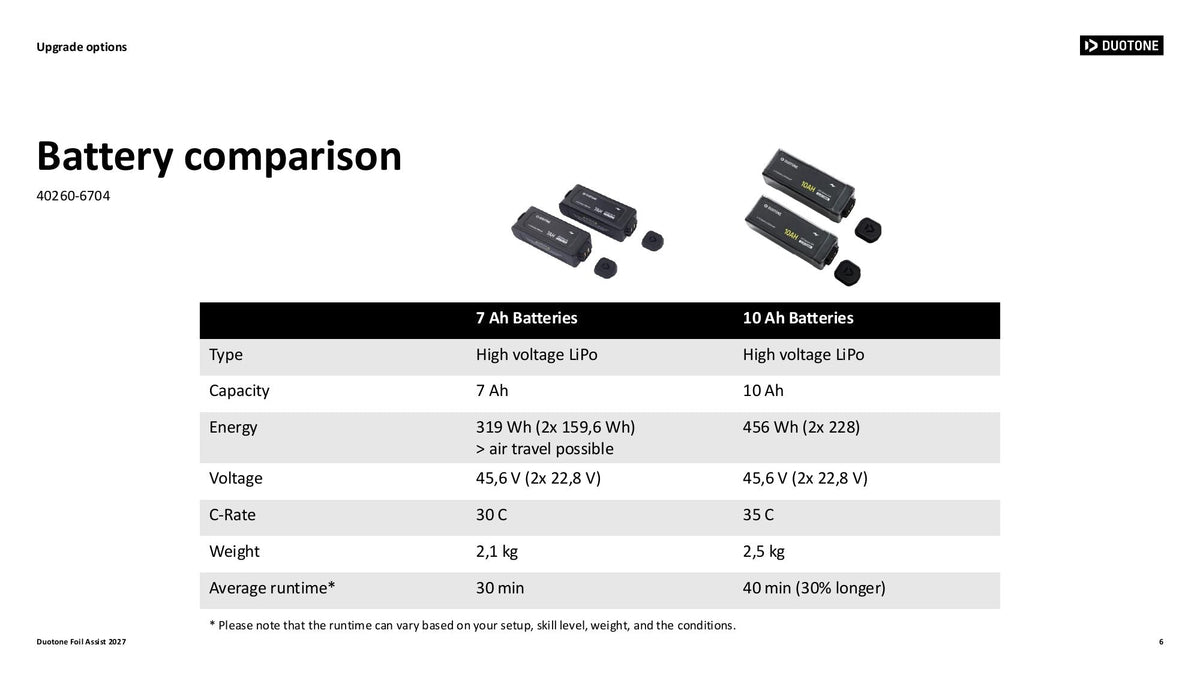
Every 2027 Duotone Foil Assist set now ships with the new 10Ah battery set instead of the 7Ah. The headline is about 30% more runtime. The bit people miss is that the 10Ah batteries are physically longer, so they don't fit a 2026 eHarness without an upgrade kit.
I've now had the 10Ah set out on the water, so as well as Duotone's figures you'll find my own first-hand results below. Here is the straight comparison, my real-world test, what you need to run 10Ah batteries on the kit you already have, and the one situation where the old 7Ah set is still the better choice.

Duotone's own comparison: 7Ah against 10Ah.
|
48 min
My full-trigger session, 10Ah
|
+13 min
Over my 7Ah session
|
1h30
Charge time
|
~0.5kg
Extra on your hips
|
7Ah vs 10Ah, side by side
| 7Ah Battery Set | 10Ah Battery Set | |
| Type | High voltage LiPo | High voltage LiPo |
| Energy | 319Wh (2 × 159.6Wh) | 456Wh (2 × 228Wh) |
| Voltage | 45.6V (2 × 22.8V) | 45.6V (2 × 22.8V) |
| C-rate | 30C | 35C |
| Weight (pair) | 2.1kg | 2.5kg |
| Average runtime (Duotone) | 30 min | 40 min |
| My test, full trigger (76kg) | Just over 35 min | About 48 min |
| Fits 2026 eHarness box | Yes | Needs Battery Box Upgrade Kit |
| Fits upgraded / eHarness 2.0 box | Yes (EVA cushion included) | Yes |
| Air travel | Possible (Duotone) | Over the 160Wh per-battery limit |
Specs from Duotone's 2027 Foil Assist presentation; the “my test” row is my own riding. Runtime varies with your setup, weight, skill level and conditions.
Same voltage, more capacity, a higher C-rate and about 200g more per battery. The higher C-rate is why Duotone say the 10Ah set gives stronger acceleration when paired with the new HT motor, not just a longer session. If you want the motor side of that, see our HT motor vs standard motor post.
10Ah on the water: my first-hand test
Duotone's averages are a good guide, but I wanted real numbers. So I tested the new kit against my old setup in very similar water: a sandy bottom and smooth between the waves. For reference, I'm 76kg and I ride an 800cm² Crest with a PX 160 rear wing on a D/LAB mast.
My old setup: 7Ah batteries, the standard motor and the SLS 3-blade propeller, on a 48L Midfish. Full trigger, catching every wave I could, I got just over 35 minutes from walking into the water to standing back on the sand. Taxiing back out in gear one instead of flying, a 7Ah set has lasted me about 55 minutes.
The new setup: 10Ah batteries and the new HT motor, with the same foil and propeller, on a 38L Midfish. Same riding style: heavy on the trigger, catching every wave I could, no waiting. I motored out nearly twice as far as usual, but the waves I rode back in were longer too, so I'd call the motor use about the same.
I got about 48 minutes of riding, and 55 minutes from the water's edge to stopping, with the last few minutes taxiing in on low power. At 35 minutes, when a 7Ah set would normally be finished, my watch was still showing about half battery. Friends on 7Ah batteries had to go in before me.
That's around 13 minutes more, which is a lot of extra waves. And it's a conservative number, because the board was 10 litres smaller and that takes more power to get going. On the same board I'd expect around 50 minutes.
More in reserve when it counts. Once the battery dropped into low-power mode, the 10Ah set kept me going in gear one for noticeably longer. With the bigger battery I had the confidence to go further out, so that reserve really mattered. I've had to paddle back in on a 7Ah set at the same spot before.
Weight: you won't notice it. The 10Ah batteries are about 400g heavier as a pair, and with the bigger battery box it's roughly half a kilo extra in total. That was my main worry going in, but once it's on your hips you really don't feel it.
If you ride surf-style, taxiing back out in gear one and waiting for sets rather than blasting around, I reckon a 10Ah set could give you up to an hour and a half. I'll confirm that once I've timed a full session.
How it compares with Foil Drive. The 10Ah set (456Wh) is almost like for like with the Foil Drive MAX Power battery (499Wh). It has a little less energy, but there's no battery box under the board, so there's less drag and it's easier to get going. Foil Drive still has a small edge on runtime, but only just. We go into that in our Foil Drive vs Duotone Foil Assist comparison.
Honestly, I was really happy with the 10Ah batteries. Got any questions about what you'd get from either battery? Give us a shout.
What else comes with the 10Ah set

10Ah Battery Set — shipped with connector caps and a fire-resistant battery bag.
The batteries come with connector caps and a fire-resistant battery bag. They charge on the existing charger, so there's no new charger to buy if you're upgrading. Duotone quote about an hour and a half from a normal UK socket.
On safety, the 10Ah battery has been through UN38.3 testing at an independent lab. That's the standard set of transport tests every lithium battery has to pass: altitude, thermal cycling, vibration, shock, short circuit, crush, overcharge and forced discharge. It passed all eight.
Running 10Ah batteries on a 2026 Foil Assist

Battery Box Upgrade Kit — everything needed to fit 10Ah batteries in a 2026 eHarness.
Because the 10Ah batteries are longer, the battery box cover on a 2026 eHarness has to be swapped for a bigger one. Your existing box still works; you just need the eHarness Battery Box Upgrade Kit, which includes:
A new, larger battery box cover · a larger neoprene cover · an extension cable to move the receiver onto the new cover · a pin removal tool · two spare pins · an EVA cushion so your 7Ah batteries still sit snugly if you swap back.
The new neoprene is also more flexible and forgiving, which makes it easier to zip up around the case.
The bigger box takes both battery sizes. Once you've upgraded, your 7Ah batteries still fit, using the EVA cushion. It's only the original 2026 box that can't take the 10Ah. So there's no real downside to the upgrade: it just lets you use both.
If you are buying new, you don't need the kit. The eHarness Set 2.0 in every 2027 set already has the bigger box, and takes both battery sizes.
 |
 |
eHarness Set 2.0, and the Battery Lock Box for keeping a spare set at the beach.
Do you actually need more runtime?
Swapping batteries on the Foil Assist takes about a minute. If you ride from the beach and can leave a spare set nearby, two 7Ah sets give you more total time on the water than one 10Ah set. Duotone's new Battery Lock Box is built for exactly that: a padded, water-resistant case that locks to a fence or post, with room for one battery set, your phone and keys. It comes with the HT D/LAB sets.
Where the 10Ah set wins is one long session without stopping, and the extra reserve to go further out with confidence. Duotone also call it the battery choice for heavier riders.
If you fly with your kit, read this
Airlines work to a limit of 160Wh per lithium battery. The 7Ah batteries are 159.6Wh each, just under it, and Duotone list them as suitable for air travel. The 10Ah batteries are 228Wh each, which puts them over that limit.
So if you travel to foil, keep a 7Ah set for trips, and always check your airline's own rules before you book. Rules differ between airlines, and they change.
💡 Sam's Tip
If you already own a 7Ah set, don't sell it. A 10Ah set for home sessions plus the 7Ah set for travel, or as a quick swap at the beach, is a great combination. And if you're buying new, every 2027 set already comes with the 10Ah batteries.
10Ah batteries and upgrade kits
Tell us which eHarness you have and we'll make sure you get the right parts first time.
Foil Assist Batteries Email Us Your Setup