
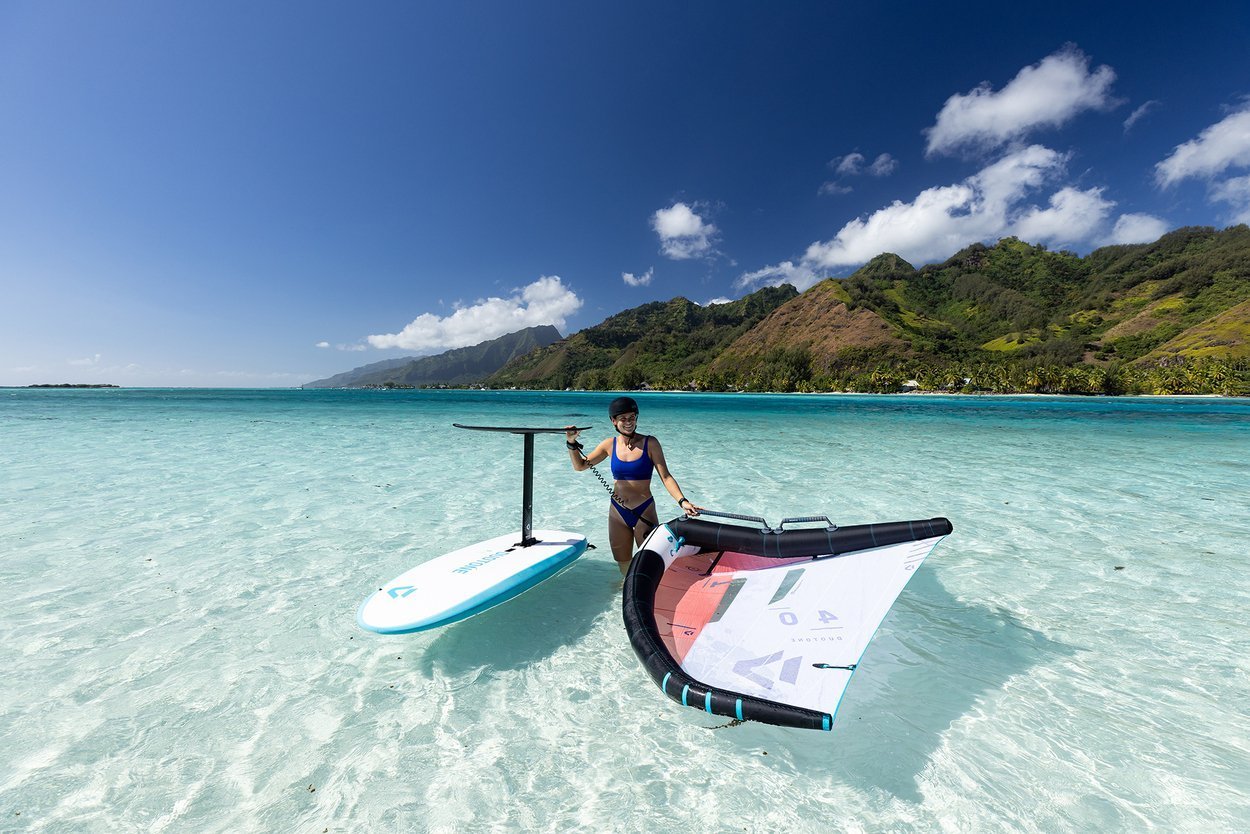
If you’re asking “what do I need to start wing foiling?”, you’re not alone. Foil Winging is one of the most exciting ways to get more time on the water, with early lift, smooth cruising, and impressive upwind ability compared to traditional windsurfing.
At Worthing Watersports, we help beginners get into foil wing every week. Below is a complete checklist of wing foiling equipment for beginners, plus practical advice on what to prioritise so you progress quickly without wasting money.
1) Wing Foil Board
Duotone Sky Start – Complete Beginner Option
If you are a complete beginner, the Duotone Sky Start is the most stable way to learn windfoiling. It’s essentially a school / centre board used by many recognised coaching centres.
- Very large, stable platform
- Extremely durable construction
- Soft deck for comfort and safety
- Deck markings to help with foot placement (especially without straps)
It’s not the board most riders buy for long-term progression, but it can make sense if you’re a heavier rider, don’t have easy access to lessons, or want maximum stability for your first sessions.
Duotone Sky Free – Most Popular First Board
The Duotone Sky Free is the most popular first wing foil board we sell. It’s wide, stable, easy to climb onto, and designed specifically for progression.
Beginner volume guide:
- First board: bodyweight (kg) + 30 litres
- Progressing rider: bodyweight (kg) + 20 litres
Example: A 70 kg rider often starts around 100 L. An 80 kg rider often starts around 110 L. If you already have wind awareness (windsurfing / kitesurfing / sailing), you may be comfortable with slightly less volume.
2) Wing Foil - Foil Setup (Mast, Fuselage, Front & Rear Wings)
Mast length – start shorter (around 75 cm)
For learning, we recommend a shorter mast (around 75 cm). It helps you build proper pitch control and “height awareness” so you actually learn where the foil is under the water.
Longer masts are great later for rougher water and waves, but starting too long can slow progression and mask bad habits.
Fuselage length – stability first
- Longer fuselage = more lift, more stability, slower response
- Shorter fuselage = more reactive/twitchy (better for advanced wave riding)
For beginners, a longer fuse (roughly 74–75 cm) is a strong starting point. As you progress, you can shorten things up to gain manoeuvrability.
Aluminium vs carbon mast
We usually recommend aluminium masts when you’re starting:
- More cost-effective
- Plenty stiff enough for learning
- You may upgrade mast length later, so it’s sensible not to overspend early
Carbon masts reduce weight and add a more responsive feel (especially in waves), but they’re not essential at the beginning.
Tip: Look for Quick Mount (QM) systems if you want faster setup/pack-down. You can leave the plate on the board and remove the mast with a single bolt.
Front & rear wings – choose a forgiving foil first
Foils vary massively. The right beginner foil will make wing foiling feel manageable and fun from day one.
Beginner option: A larger, slower foil e.g. Duotone Lift - gives stable, gradual take-off so you can focus on stance, wing handling, and sailing comfortably.
Most popular progression option: A mid-aspect freeride foil e.g. Duotone Free is ideal once you’re moving past the first sessions. It balances easy take-off, stability, cruising speed, and turning.
We don’t recommend jumping straight into very high aspect foils (more twitchy) or wave-specific foils as your first purchase.
Watch: We’ve got a handy explainer video on the Duotone foil range here:
3) Wing (handheld wing)
Your wing is the engine. A well-built wing holds its shape, delivers power smoothly, and makes learning far easier than a soft, saggy wing.
We’re big fans of Duotone wings for first-time riders because they’re stable, well finished, and predictable. For most people, the standard Duotone Unit is the best place to start (SLS and D/LAB are higher-end upgrades, but not necessary for your first purchase).
Wing size basics
- <70kg: 4.0 - 5.0m
- ~70-85kg kg rider: 5.0–5.5 m
- Heavier / taller riders: 6.0–6.5 m
Avoid going too big: larger wings have more drag in the water during learning. Most riders build a quiver with 1.0–1.5 m gaps between sizes as they progress.
4) Leashes (essential)
You’ll need two leashes:
- Board leash (recommended: waist belt + coiled leash)
- Wing leash (wrist or waist, personal preference)
We often recommend a waist belt for the board because it keeps the leash out of the water and reduces tangles with the foil when you’re switching stance.
5) Board bag (recommended for hard boards)
If you’re buying a hard board, a padded board bag is one of the best investments you can make. It protects the board from dents and scratches in the car and keeps it in better condition long-term.
Tip: Board bag sizing is usually listed by internal dimensions, so always make sure the bag is big enough for your board.
6) Inflatable vs hard wing foil boards
Inflatable boards
- Very durable and harder to damage
- Easier to store and transport
- Often significantly cheaper
- Slight performance loss (typically marginal)
Modern inflatable foil boards are far better than most people expect. Duotone inflatable boards use a large carbon plate in the foil area to keep the connection solid.
Hard boards
- Maximum performance and efficiency
- More direct feel and responsiveness
- Usually lighter on the water
7) Pump (manual or electric)
You’ll need a pump for your wing. Manual pumps work fine and are cost-effective, but electric pumps are increasingly popular because you can set an exact pressure and inflate hands-free while you prep the rest of your kit.
8) Wetsuit & safety equipment
Especially when learning, we strongly recommend proper warmth and protection:
- Wetsuit (UK guide: 5/4 winter, 4/3 spring/autumn, 3/2 summer)
- Helmet
- Impact vest
Wetsuit fit varies a lot by brand and body shape, so if you can, it’s always worth trying suits on in-store.
Final thoughts: start stable, progress fast
Wingfoiling can look complicated at first, but with the right beginner setup it becomes straightforward — and progression is incredibly rewarding.
Our general advice is simple:
- Start with stability (board volume + forgiving foil)
- Don’t over-buy advanced foil gear too early
- Build your kit step-by-step as your skills grow
Order today from Worthing Watersports – the UK’s Duotone specialist store.