
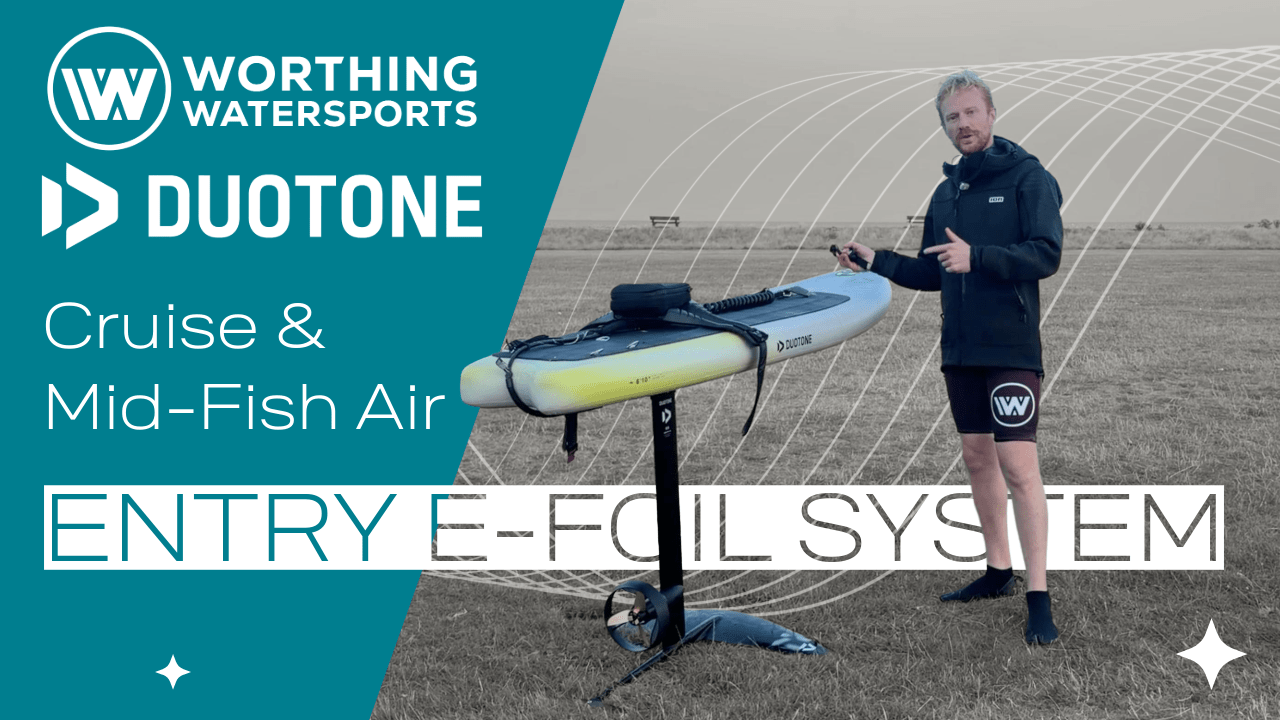
We got Cyril — the designer behind Duotone's whole Foil Assist system — to walk us through the Midfish Air and the Foil Cruise set. If you've watched our earlier videos on the Foil Assist, this is the other half of the story, and it's the one most people should probably be looking at first.
Short version: the Midfish Air is an inflatable board built specifically for e-foiling, it costs £899, and paired with the Cruise set it makes a powered foil setup you can genuinely learn on — and then fly abroad with, which is not a sentence you can normally say about an e-foil.
Cyril's own take was the bit that surprised us. He isn't riding it because he designed it. He rides it on flat days because it's the lightest e-foil he owns.
Everything below is covered in the video — watch the full walkthrough with Cyril on YouTube, or read on if you'd rather have it in writing with the numbers laid out.
|
£899
Midfish Air, in stock
|
65cm
Motor below the board
|
1 bag
Rolls up, flies as luggage
|
6'10"
One size, that's it
|
Cruise or Assist? They are not the same thing
This trips people up constantly, so it's worth being blunt about it. Duotone make two powered foil systems and they are built for opposite jobs.
Foil Cruise puts the motor pod 65cm down, near the bottom of the mast. It behaves like a conventional e-foil, the motor stays in the water the whole time, and it comes with a prop guard so you can't catch the prop with your foot. This is the one for flat water, cruising, and learning.
Foil Assist puts the motor 15cm from the top, so it lifts clear of the water once you're up. That's what you want for catching waves and downwinding — it's an assist, not a permanent engine. Buying the wrong one is an expensive mistake, so if you're unsure, ask us before you order.
"It's not just a beginner board, it's a fully fun board and I use it a lot. It's basically the lightest e-foil that you can have. On flat days I just love to use it."
— Cyril, Duotone Foil Assist designer
Why an inflatable, and why it isn't a compromise
The obvious objection to an inflatable is that it must be the cheap option. It isn't really. The Midfish Air has the same carbon plate in the bottom as the Sky Rider and Sky Air, so the foil mounts to something properly stiff rather than to air.
What you actually get is a board you can stop worrying about. You will fall on it while you're learning, and it will not hurt you. You can drop it on the slipway, bash it in and out of the van, and nothing meaningful happens to it. For a discipline where everyone falls off repeatedly for the first few sessions, that matters more than a few grams.
It inflates like a normal paddleboard and rolls up around the carbon plate. Everything — board, foil, mast — goes into one wheeled bag about a metre tall. That's the part Cyril was most pleased about: you cannot normally fly with an e-foil. With this you can, with the batteries in your hand luggage.
The battery doesn't have to go on your back
Normally you wear the battery in a harness on your back, with the leash running through to an integrated mast — no cable trailing down the outside. That's the right setup for waves and anything high-performance.
But if you're learning, or teaching, or putting a kid on it, you can take the harness off entirely and mount the box on the tail instead using the Battery Box Mounting Set (£509). Then there is nothing on your body at all except the remote in your hand. Getting to your knees and standing up is far easier with no leash and no power cable to tangle in your legs.
One clever detail Cyril pointed out: with the box on the tail, a heavier rider lying prone can sink the tail under water, and the receiver is inside that box. So there's a thin pipe running up the board that you thread an antenna through to the nose. Signal stays up, motor doesn't cut. It's the sort of thing you only think of after it's gone wrong on someone.
Handing the remote to the instructor
This one sounded odd to us at first, but it makes sense. There's only one remote, and it doesn't have to be held by the person on the board. The instructor keeps it, controls the power, and the learner concentrates purely on standing up and balancing rather than managing speed and throttle at the same time. Cyril has done it with his own kid and reckons it works well. If you're teaching someone, or nervous about handing a powered foil to a beginner, that's a genuinely useful option.
Midfish Air vs Midfish composite
| Spec | Midfish Air | Midfish (composite) |
| Construction | Inflatable, carbon base plate | Composite |
| Sizes | 6'10" only | 5'0" 28L to 6'3" 98L |
| Packs down | Yes — one wheeled bag, flies | No |
| Best for | Learning, flat water, travel | Performance, volume choice |
| Price | £899 | £1,099 – £1,299 |
💡 Sam's Tip
If e-foiling is new to you, get the Air. Not really because it's cheaper — it's £200 under the smallest composite and £400 under the big 98L — but because you will fall on it a hundred times in your first few sessions and you'll care a lot less each time. Buy the composite when you know what volume you actually want, and pair the Cruise with the bigger Aero Free front wing. That's Cyril's own combination and he's ridden it more than anyone. And if you're planning to fly with it, the Air isn't just the better option, it's the only one.
Duotone Midfish Air & Foil Cruise — In Stock
Board on its own, or the complete powered foil package. Not sure whether you want Cruise or Assist? Watch the full video with Cyril, email sales@worthingwatersports.com, or come and find us on Worthing seafront and we'll talk it through properly.
Midfish Air — £899 Complete Cruise Package — from £5,599.99